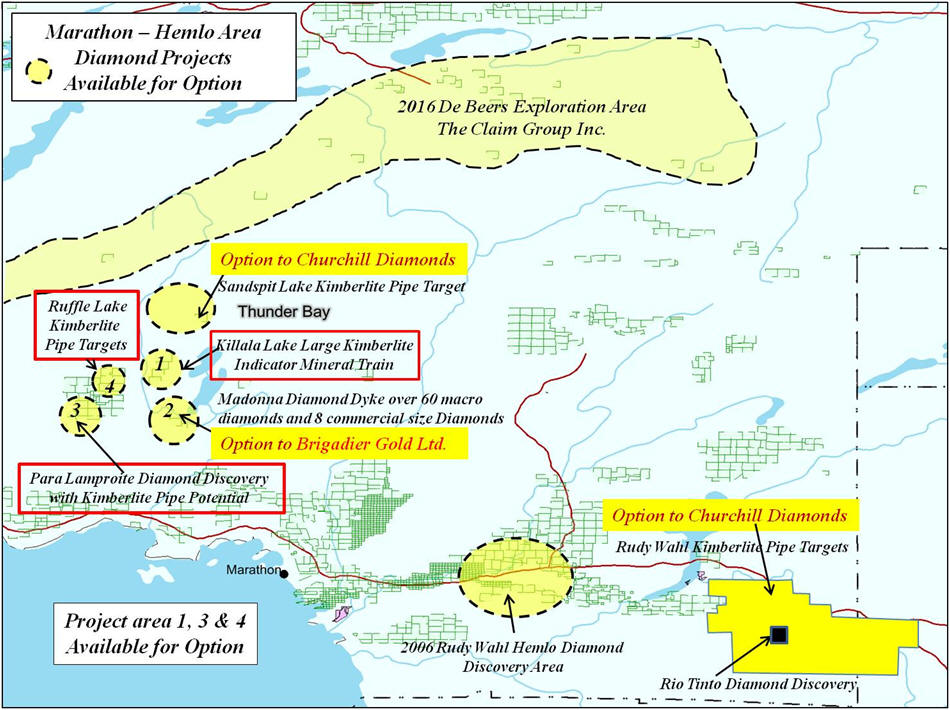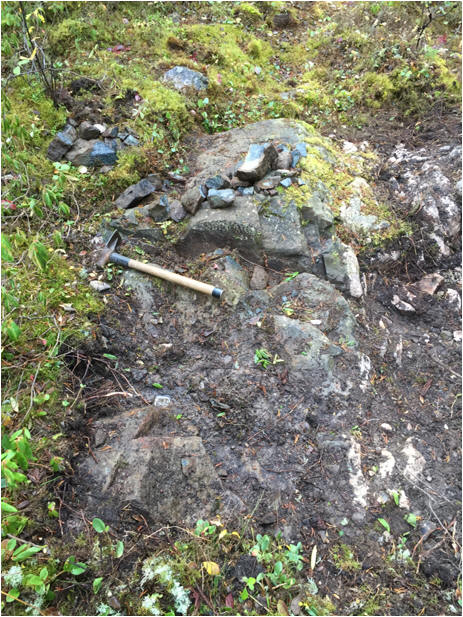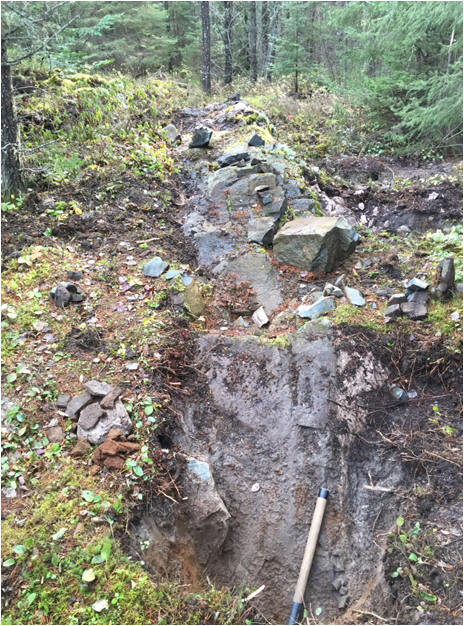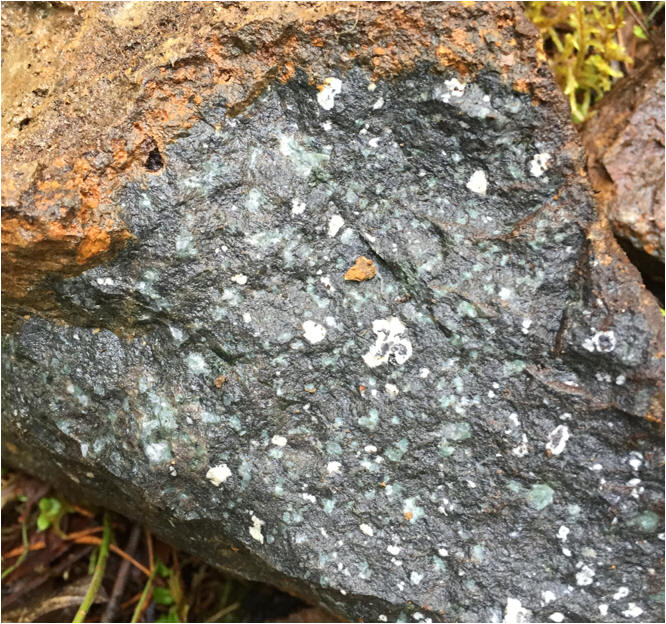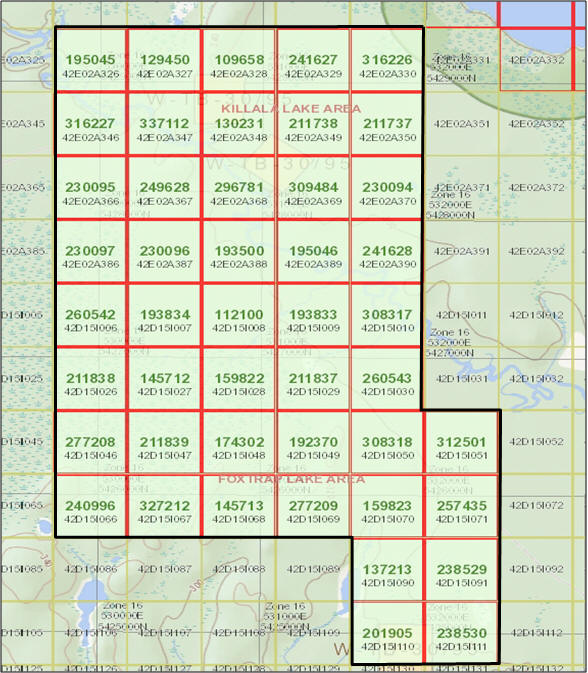




Killala Lake Area 26 Potential Kimberlite Targets

Available for Option

February 13, 2008 Dianor Resources / Rudy Wahl's
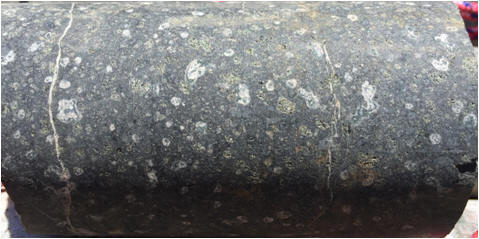
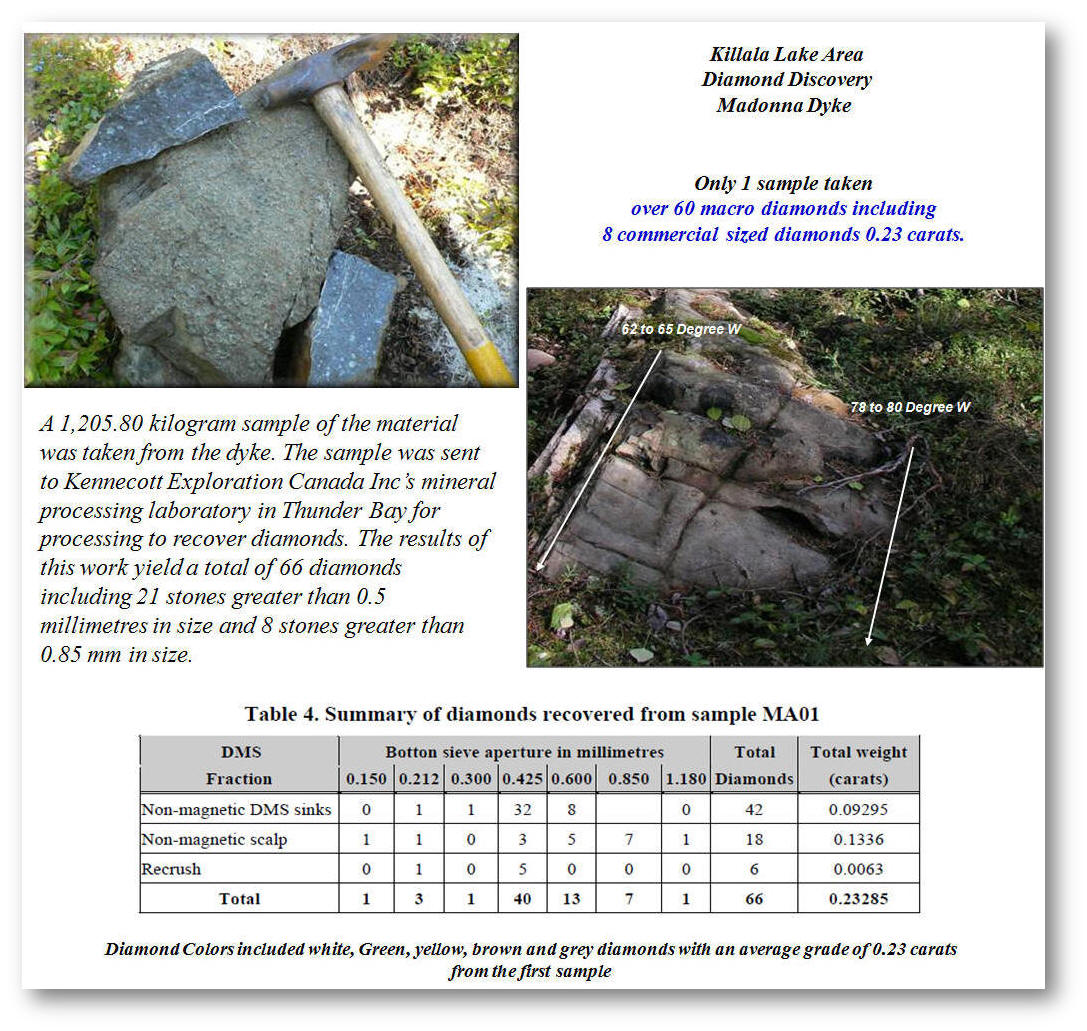
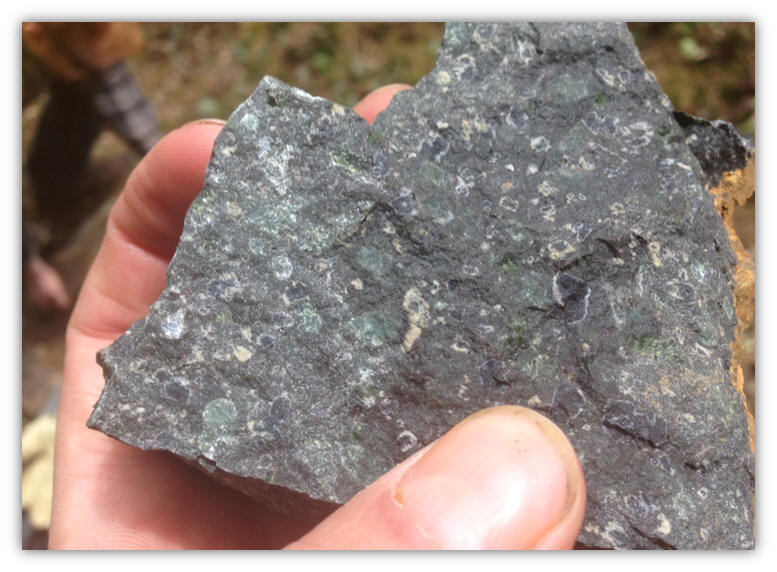
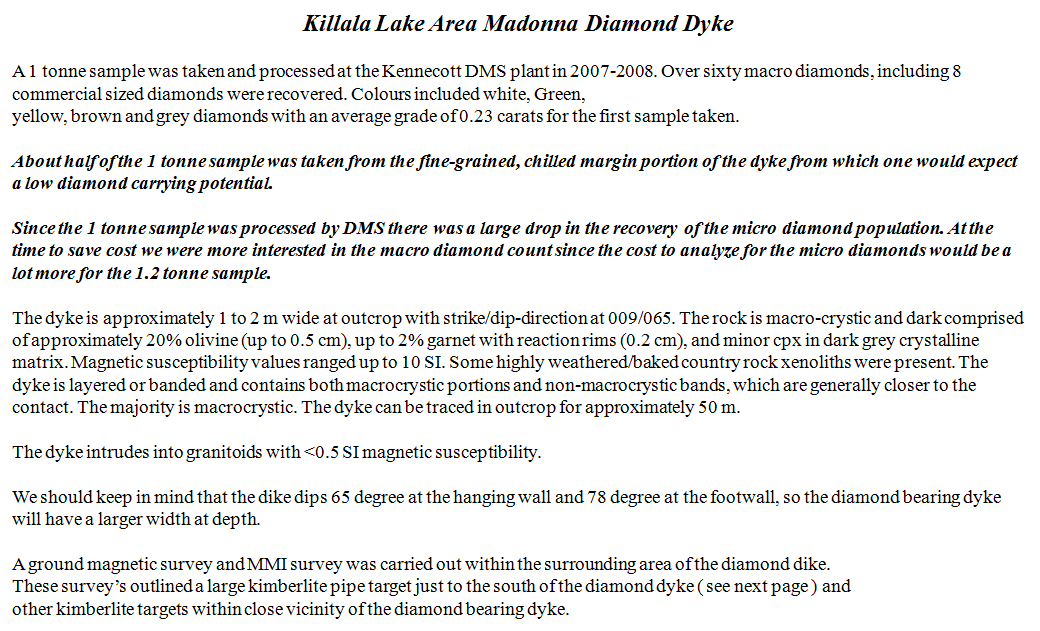
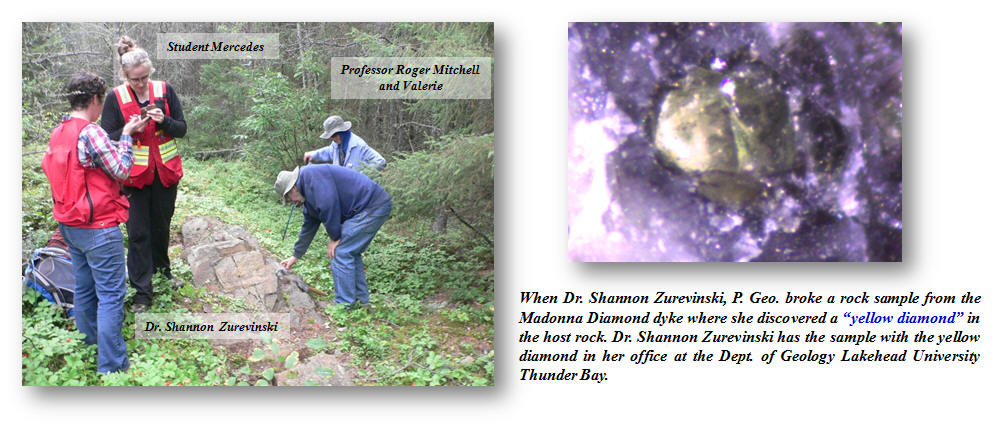
Diamond discovery in the Killala Lake area, over 60 macro diamonds including 8 commercial sized diamonds.


Property, Description and Location

The Killala Lake property consists of 135 claim units - 14 separate claim blocks in Killala Lake area and Islington Lake area Township Thunder Bay Division.

Claim No: 

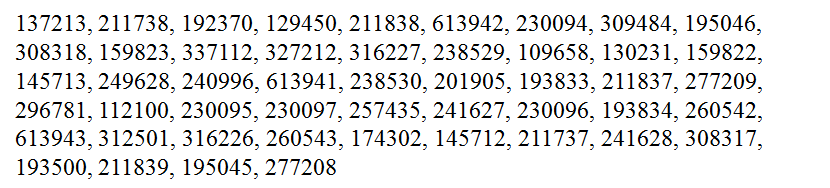
#3015220, #3015156, #4246257, #4246256, #4246264, #4246265, #4246266, #4246267, #4246268, #4246258, #4246259, #4246260, #4246261, #4246262

The property is centered approximately 55 kilometers from the town of Marathon. A network of logging roads provides access to most of the claims.

Accessibility, Climate, Local Resources, Infrastructure and Physiography:

The Killala property is situated in an area of rolling hills of relatively low relief. The maximum topographic relief is 120 metres. The property is forested with spruce and cedar. Parts of the claims have been logged. Access is by car or truck from the town of Marathon.

The property has abundant water supply from lakes and creeks within the property boundaries. Skilled and experienced mining workforce is available in Marathon. Housing and supplies are also available in Marathon. Exploration can be conducted on a year-round basis. The extent of the property provides a large land base for a future production facility, associated tailings facility, and potential waste dumps.

Regional Geology:

The claim blocks lies at the junction of the Wawa and Quetico subprovinces of the Superior Structural Province of the Canadian Shield. The rocks comprise east-west trending interbedded Archean meta-sedimentary and meta-volcanic rocks intruded by granitic and mafic intrusive rocks. Younger Proterozoic intrusions include the Marathon diabase dyke swarm and alkalic intrusions, of the Coldwell and Prairie Lake alkalic-carbonatite complexes and lamprophyre dykes. The large number of dykes mapped in the area is clearly evident in the airborne magnetic survey as long linear anomalies with a variety of strikes. Including are some distinct magnetic lows that appear to reflect a north-northeast set of lamprophyre dykes.

The Trans-Superior Tectonic Zone (TSTZ) extends north-northeast through the area and appears to be the locus of the considerable intrusive activity present. The TSTZ is similar to other tectonic features in the Canadian Shield, such as the Kapuskasing Structural Zone and the Lake Timiskaming Structural, along which diamond deposits have been found. Indeed, diamondiferous kimberlites have been found in Michigan on the southern extension of the TSTZ. These major structures provide deep-seated zones of weakness that tap into the mantle and provide conduits along which kimberlites ascend.

Note from the OGS open file report # 6013 - 2000 page 45, where the new Diamond discover is located.

Caution is warranted, the upper part of the Little Pic River area may be a good place to explore for kimberlite for several reasons. These include:   1) there are not one, but 3 sites that have a strong KIM signature while other sites around them do not; 2) each site consists of more than one KIM type; 3) the river does cut to bedrock; 4) all 3 sites are located at a major intersection between structures associated with the TSTZ and the Killala Lake Deformation Zone; and 5) there are a number of magnetic anomalies (bull's-eye) immediately up-ice from the sites as illustrated on magnetic maps.

P1 Pyrope:

All the pyrope grains identified in Killala Lake area panned samples were classified as P1 pyrope. They are characterized by clastic grain shapes, presence of Type-I and Type-II primary magmatic surface microrelief, absence of grains with kelyphitic rim fragments, absence of mechanical erosion marks, predominance of -0.5+0.25 mm grains, and wide variation in mineral chemistry, including the presence of diamond association (G10) pyrope grains, which might point to the presence of diamondiferous rocks in the study area. P1 pyrope is of prime exploration interest, the more so that in Killala Lake area samples it occurs in association with other KIM. They may be related to continental-type (short-transit) dispersion haloes.

Among the picroilmenites identified in Killala Lake area panned samples are representatives of two distinct genetic groups. Group I1 (short-transit ilmenite of kimberlitic origin) includes numerous picroilmenite grains, which are similar in mineral chemistry (primarily in MgO-TiO2 relationship) to kimberlitic picroilmenite. Group I3 (long-transit kimberlitic picroilmenite) includes grains with moderate mechanical erosion (roundness class 2 to 4), which may be related to long-transit continental-type dispersion haloes. Of prime exploration interest are samples with a high I1 picroilmenite content. I1 picroilmenite occurs in Killala Lake area samples in association with other Group1 kimberlitic minerals (pyrope, chrome-diopside, chrome spinel and olivine). Absence of mechanical erosion marks on I1 grains along with the presence of perovskite rims and the fact that many samples contain +1 mm picroilmenite grains and grains with fragments of kimberlitic-like material (and even kimberlitic-like rock fragments) suggest that the primary source(s) of these grains are nearby, most probably, within the boundaries of the dispersion halo. Some distinctions in mineral chemistry between picroilmenites from the main linear halo and from other local areas might point to the presence of some kimberlitic-like primary sources unrelated to the main linear halo within or nearby the study area.

CONCLUSIONS:

Panning exploration of Quaternary sediments in Killala Lake area allowed to identify a linear zone a multimineralic, high-contrast dispersion halo of short-transit kimberlitic association KIM-1. This zone appears as a narrow (not wider than 1 km), 20 km long, NE-trending zone extending along the western shores of Route Lake, Kilala Lake and Sandspit Lake, from the left side of Little Pic River on the SW to Kagiana Lake on the NE. This zone, denoted as Promising area A, is also characterized by the presence of picroilmenite grains with spots of kimberlitic material and even fragments of kimberlite rocks in panned samples. The presence of kimberlites within this zone is doubtless. The southwestern part of this zone is best prepared for direct exploration for kimberlites. The high abundance and ubiquitous occurrence of picroilmenite grains within the halo and the high concentration of picroilmenite in the samples might suggest that the kimberlitic source is rather large, or that there is much more than one kimberlite body in this zone


Area "A"


Promising area "A", is also characterized by the presence of picroilmenite grains with spots of kimberlitic material and even fragments of kimberlite rocks in panned samples. The presence of kimberlites within this zone is doubtless. The southwestern part of this zone is best prepared for direct exploration for kimberlites. The high abundance and ubiquitous occurrence of picroilmenite grains within the halo and the high concentration of picroilmenite in the samples might suggest that the kimberlitic source is rather large, ot that there is much more than one kimberlite body in this zone.


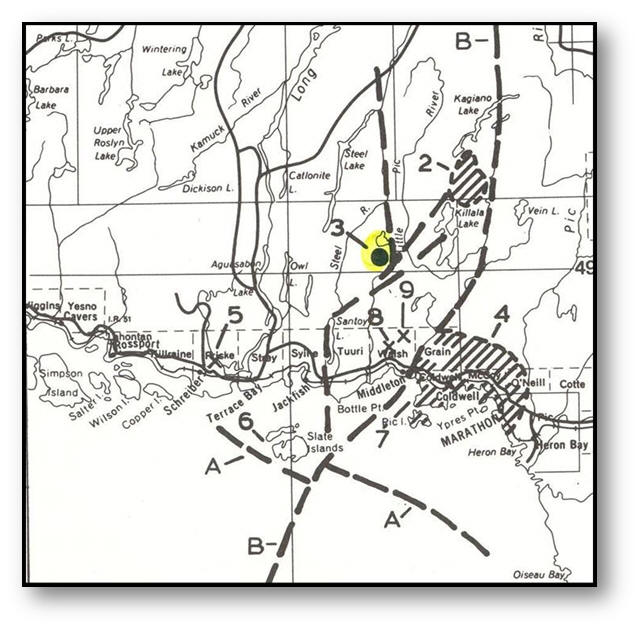
Regional Structural Setting

Figure 13: Major carbonatite - alkalic intrusions and major regional faults. 1) Chipman Lake fenites and carbonatite dikes; 2) Killala Lake alkalic complex; 3) Prairie Lake cabonatite; 4) Port Coldwell alkalic complex; 5) Gold Range diatreme; 6) Slate Islands diatremes and carbonatite dikes; 7) Neys diatreme; 8) McKellar Creek diatreme; 9) Dead Horse Creek diatreme; A) Michipicoten Island fault; B) Big Bay - Ashburton Bay fault and its extrapolated northern extension.

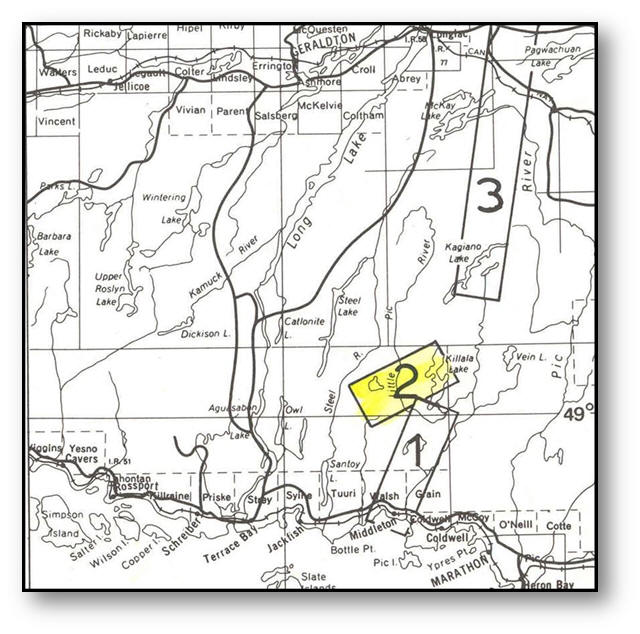
Recommendations for Regional Exploration

Figure 14: Areas recommended for prospecting for diatreme / kimberlite structures. Areas are numbered in order of decreasing priority.

 

Action Button: Custom: Back to Top